Feeling better at rest and being ready for a postal shift are different milestones. A carrier may still struggle with repeated steps and vehicle entry, while a mail handler may find that a lift feels manageable once but becomes difficult when repeated. Returning to meaningful work begins by understanding those specific demands.
For USPS employees recovering from an accepted work injury, physical therapy can help develop relevant movement, strength, control, and activity tolerance. Greenbelt Physical Therapy & Sports Medicine supports that rehabilitation process and documents functional progress. Work-status decisions, required physician evidence, agency assignments, and OWCP claim decisions remain with the appropriate parties.
Start with your actual assignment
Two postal employees with the same job title may perform different tasks. A route may involve long walking distances, stairs, uneven surfaces, parcels, or frequent vehicle transfers. A sorting or mail-handling assignment may involve repeated reaching, gripping, tray handling, or moving containers. Describe what you really do rather than relying on a job title alone.
Useful details include typical weights, where a load starts and ends, how often a task occurs, how far you carry it, and the time available for rest. Tell your therapist about the length of the shift, footwear requirements, changes in assignment, and any modified duties. Your current written restrictions are essential to deciding what practice is appropriate.
Connect the injured area with the tasks it limits
A back injury may affect bending, carrying, or getting into a vehicle. A shoulder injury may interfere with placing mail or parcels at different heights. Knee, ankle, or foot limitations may make curbs, stairs, route walking, and standing difficult. Hand and wrist problems may affect gripping, sorting, or controlling a tool.
These examples help shape the evaluation; they do not establish a diagnosis or work-related causation. Your medical assessment and accepted condition define the clinical and claim context. Share all symptoms, especially if a concern is new or falls outside the body areas currently approved for treatment.
Build a baseline before increasing the challenge
Your therapist may assess relevant motion, strength, balance, movement quality, and tolerance for selected tasks. A baseline might include the support needed for a step, the quality of a permitted reach, or the response to a short period of walking. Testing is chosen for your condition and restrictions rather than asking you to recreate a full postal shift.
The same task can be reassessed over time under similar conditions. This helps distinguish a meaningful improvement from a good moment during one visit. Tell your therapist what happens later that day and during approved activities, because immediate performance is only part of the picture.
Progress task demands in manageable stages
Rehabilitation may start with targeted mobility and strengthening, then connect those gains with suitable work tasks. A task can be simplified by reducing the load, reach height, distance, speed, or number of repetitions. As appropriate, one or more demands can gradually increase while your response is monitored.
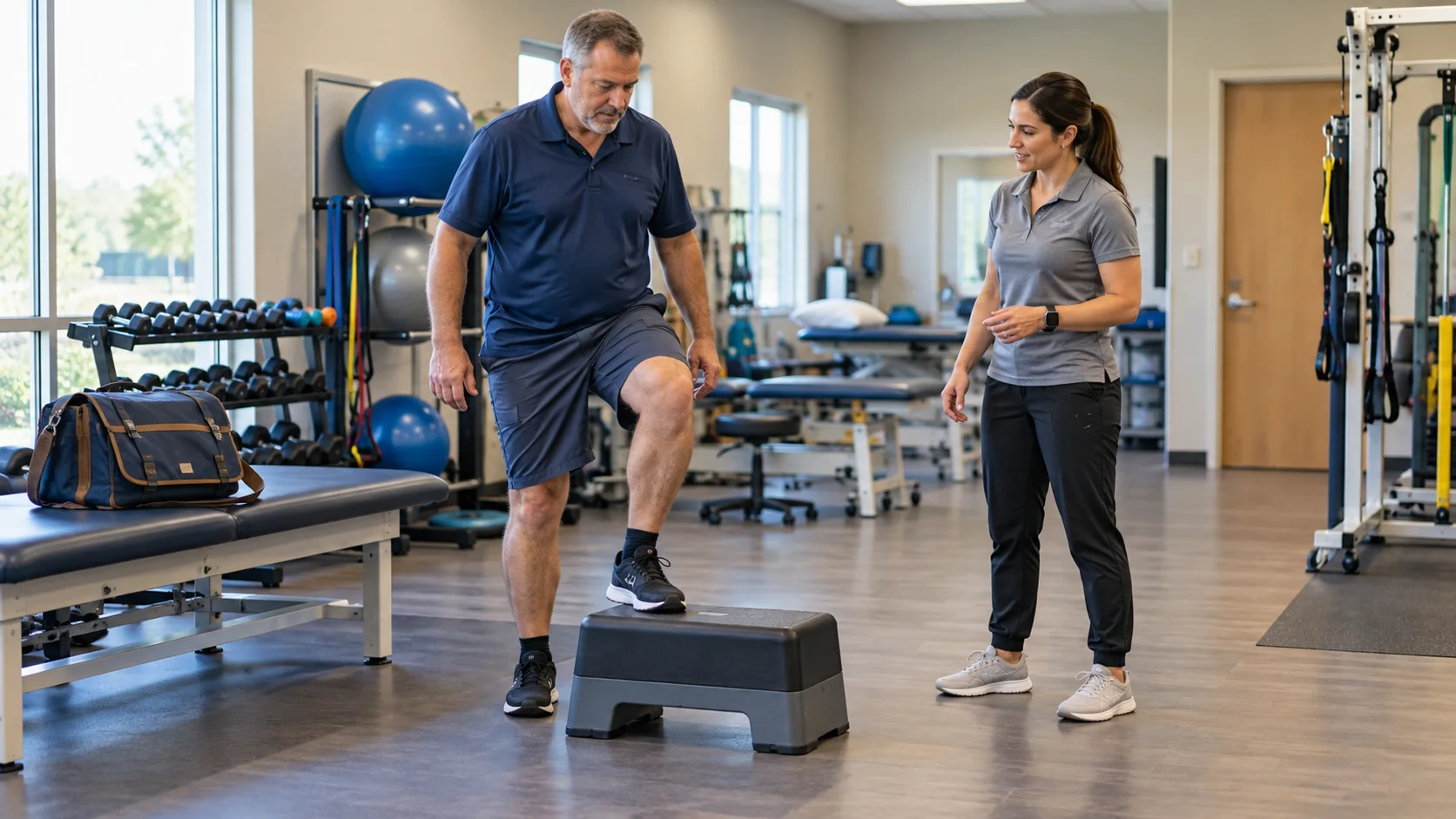
For example, a medically cleared worker with a knee injury may practice controlled stepping before adding repeated vehicle-entry movements. A worker with a shoulder injury might first develop permitted arm control and later practice placing an approved object at a relevant height. These are illustrative examples, not a program everyone should copy.
A heavier weight is not always the next useful challenge. Repetition, balance, grip endurance, pace, and recovery between efforts may matter just as much. Your therapist considers the demand that is limiting you and keeps the progression within medical guidance.
Use pacing and task strategies without losing sight of capacity
Pacing can help make an approved activity more manageable while capacity develops. That might mean breaking a task into shorter periods, varying position, or using a different handling setup when allowed. The strategy should fit the work environment and the restrictions set by the treating physician.
Physical therapy can also explore practical movement options, such as load placement, stepping strategy, or a more comfortable reaching position. There is no universal posture that makes every task safe. Equipment, staffing, routes, and workplace hazards may also need attention through the employer’s processes.
Know when work conditioning or an FCE may be relevant
Some employees need a more focused program to develop work capacity after initial rehabilitation. Work conditioning may be considered when the referral, medical status, and authorization support that next step. The program should be appropriate to the person’s current abilities and actual job demands.
A Functional Capacity Evaluation serves a different purpose: it assesses selected functional abilities at a point in time. It is not simply a harder therapy visit or an automatic clearance test. Discuss the reason for the referral, what question the evaluation is intended to address, and the required authorization with the responsible medical and claim contacts.
Make progress reports useful to the treating physician
Clear therapy records can describe the task performed, any load or assistance, movement quality, symptoms, and the response to progression. Reports can also explain what remains limited and what goals are being addressed. This gives the treating physician specific rehabilitation information to consider alongside the medical examination.
A brief lifting task in the clinic should not be described as proof of unrestricted all-day lifting ability. The report should state what was actually observed and the conditions under which it occurred. Your therapist can communicate relevant findings, but physician-required duty-status reports and medical opinions still need the appropriate physician.
Keep the return-to-work plan and the claim process connected
Ongoing OWCP-funded treatment must relate to the accepted injury and meet applicable requirements. Before starting a new program or extending care, confirm the prescription, service scope, and any required authorization. A recommendation, a submitted request, and an approval are different stages.
Therapy records alone do not establish claim approval or entitlement to wage-loss compensation. OWCP makes claim decisions, while your physician and agency have their own roles in medical restrictions and work arrangements. Keep the appropriate contacts informed of new symptoms, changed duties, or updated instructions.
How Greenbelt PT can support your next step
We can help translate the physical demands you describe into practical rehabilitation goals and provide therapy evaluations and progress records. Our office can coordinate appropriate treatment-related information with your physician and review referral or authorization questions relevant to your care.
Bring your current medical restrictions, available claim and authorization details, and a clear description of your assignment. Together we can discuss a rehabilitation plan focused on what you need to do, what is currently permitted, and how progress will be measured. A realistic plan supports recovery without promising a fixed return date.
A Work-Demand Worksheet to Bring to Therapy
- List your current assignment and whether duties are modified.
- Describe loads, handling heights, carrying distances, and repetition.
- Note walking surfaces, steps, standing duration, and vehicle transfers.
- Bring current physician restrictions and available approved-care information.
- Record which tasks are difficult and how symptoms respond during and after activity.
Common Questions
Can I copy a coworker’s return-to-work exercise program?
No. Your procedure, accepted injury, restrictions, and physical abilities may differ even if the job title is the same. Use the program prescribed for you.
Does performing a task once mean I am ready for a full shift?
Not necessarily. A shift can involve repeated effort, sustained positions, and recovery demands not captured by one clinic task. Progress should be interpreted in context.
Who decides whether I can return to full duty?
Discuss medical restrictions and work status with the treating physician and appropriate agency contacts. Therapy findings can support the discussion but do not independently guarantee clearance.
Will an FCE or work-conditioning referral automatically be covered?
No. Confirm the purpose of the referral and the applicable accepted-condition, prescription, provider, and authorization requirements before scheduling.
Further Reading
ChoosePT: Benefits of Physical Therapy ↗DOL: Vocational Rehabilitation and Work-Focused Programs ↗NIOSH: Work-Related Musculoskeletal Demands ↗ChoosePT: Benefits of Physical Therapy ↗DOL: Information for Medical Providers ↗Reviewed against official guidance: October 16, 2026. Confirm current forms and requirements with the responsible agency.
General educational information, not a diagnosis or individual treatment or legal advice. Your clinician can discuss your medical needs; an appropriate legal professional can address claim questions.
Your Comeback Starts Here
Physical Therapy in Greenbelt, Maryland
Greenbelt Physical Therapy & Sports Medicine Inc.
7241 Hanover Parkway, Suite A
Greenbelt, MD 20770