A work injury can interrupt more than your shift. It can make walking your route, lifting a tray, reaching a shelf, sleeping comfortably, or keeping up with family responsibilities harder. For a USPS worker or another federal employee, recovery may also involve unfamiliar claim requirements and several people asking for different information.
At Greenbelt Physical Therapy & Sports Medicine, our role is to support rehabilitation and provide clear therapy documentation. We can review the treatment information relevant to scheduling, coordinate records and authorization questions, and communicate rehabilitation findings to your treating physician through appropriate channels. OWCP makes claim decisions, and physician-required medical evidence remains necessary.
Federal work injuries and the demands behind them
A postal carrier may describe a fall on steps, a twisting incident while delivering a parcel, or discomfort during repeated vehicle entry. A mail handler may have difficulty lifting trays or moving containers. Other federal employees may work in maintenance, inspections, patient care, transportation, or office-based roles. Job titles alone do not describe the physical demands that rehabilitation needs to address.
Your therapist asks what happened, which movements are affected, how often the task occurs, and what your treating physician has restricted. A sudden lifting injury, a fall, and a condition associated with repeated work exposures may require different medical evaluation and claim documentation. Physical therapy does not independently determine whether an injury is accepted as work-related.
What a work-focused therapy evaluation can assess
An evaluation can establish a starting point for pain, relevant joint movement, muscle strength, walking, balance, coordination, and functional task tolerance. The tests selected depend on your injury and current precautions. You should not be asked to ignore a surgical restriction or demonstrate every full-duty task at an initial visit.
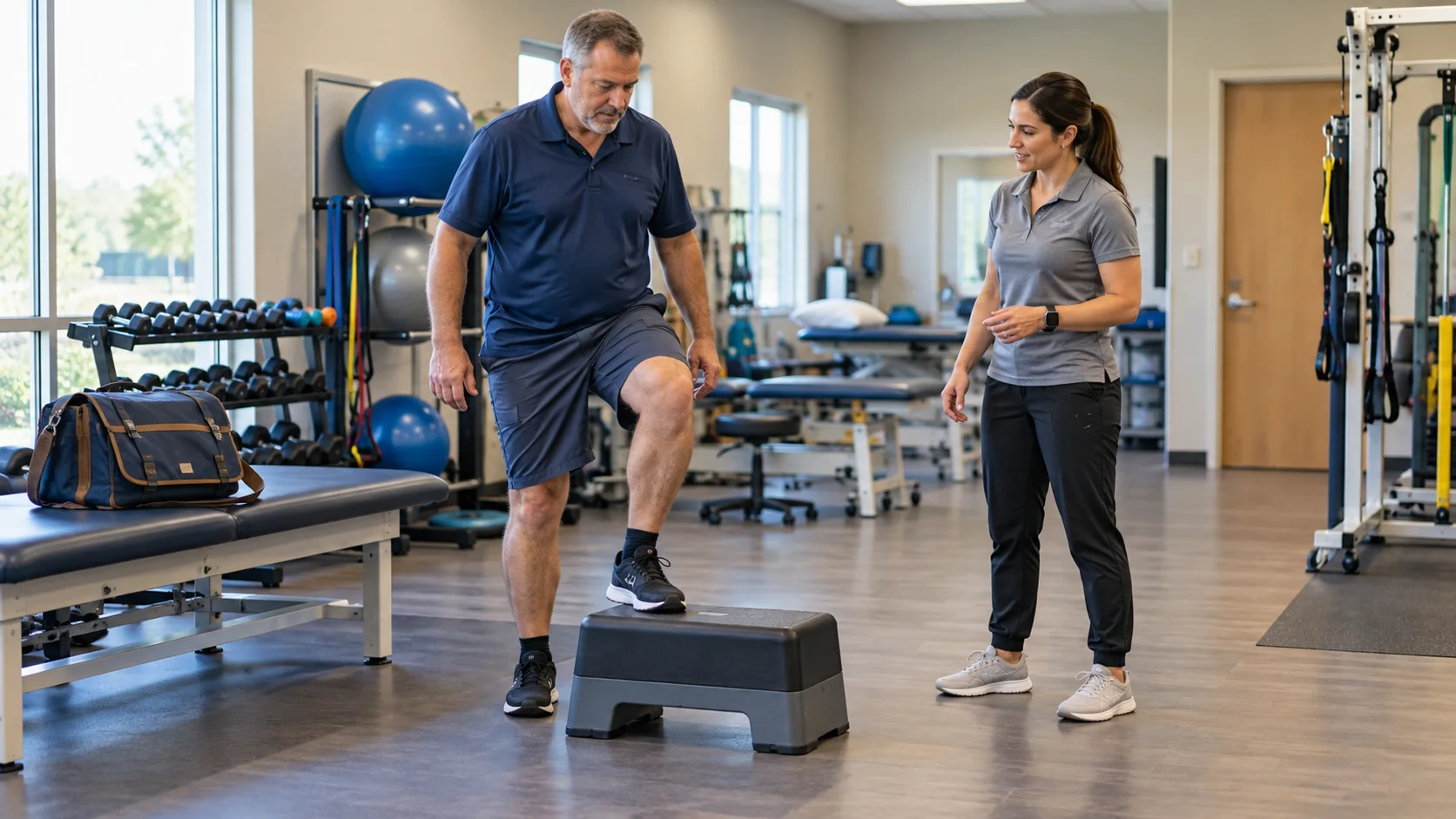
Useful goals connect findings to something you need to do. For example, a knee-injury plan may track step control and walking tolerance; a shoulder-injury plan may track permitted reaching and handling. Those goals should relate to the condition being treated and the duties you actually perform.
Building strength, mobility, and useful work capacity
Rehabilitation may combine targeted exercise, movement training, appropriate hands-on care, and education. The combination is selected for your assessment rather than using the same routine for every federal employee. Some patients first need protected movement; others are ready to develop strength, endurance, or control.
As medically appropriate, treatment can progress toward approved lifting, carrying, pushing, pulling, gripping, stairs, or vehicle transfers. Loads, repetitions, heights, and rest periods can be adjusted to match your current abilities. A practical home program helps you work on selected goals between visits without exceeding restrictions.
Progress is not defined only by a lower pain score. Being able to repeat an allowed task with better control, walk a meaningful distance, or recover more comfortably after activity can also matter. A change in symptoms, duties, or medical instructions may require the plan to be adjusted.
What therapy records can show—and what they cannot establish
A therapy evaluation and progress reports can describe the functional limitations observed, relevant measurements, treatment provided, your response, and remaining goals. Reassessment helps show how abilities are changing and why a particular rehabilitation approach is being recommended.
Consider a worker who reports difficulty climbing delivery steps. A useful therapy note may describe the observed step task, the support required, the symptoms reported, and the change at reassessment. This is more informative than a broad statement that the worker is simply better or worse. Clinic performance still has to be interpreted in context; a brief task is not proof that someone can sustain unrestricted duty all day.
Therapy records alone do not establish claim approval, medical causation under FECA, or entitlement to compensation. A qualified physician must provide the medical evidence required for the claim, including relevant opinions when requested. Therapy findings can inform that physician’s assessment but do not substitute for it.
How Greenbelt PT can support the treatment process
Our office can review your referral, case details, accepted treatment information, and any available authorization before scheduling. If a document is missing or the approval is unclear, we can explain the information needed and coordinate the therapy-related question with the appropriate contact.
We can provide therapy evaluations and progress records and communicate relevant findings to the treating physician, with appropriate consent and through suitable channels. If more treatment is recommended, the office can help coordinate the therapy documentation and any applicable authorization request. Submitting information does not guarantee approval or a particular processing time.
The patient, employing agency, physician, and OWCP each have separate responsibilities. We do not take over the employee’s claim submissions, complete physician-only medical opinions as a therapist, or make decisions for OWCP.
Keep treatment connected to the accepted injury
For ongoing OWCP-funded care, the services requested must address the accepted work injury and satisfy applicable medical-necessity, prescription, provider, billing, and authorization requirements. An accepted claim is not a blanket approval for every body area, procedure, or additional visit.
Tell your physician and therapist about new symptoms. If a new condition or body area needs to be considered, additional medical documentation and review may be required. Do not assume that attending therapy expands the accepted claim or authorizes treatment outside its current scope. Confirm what is approved before proceeding with nonemergency care.
Prepare for a more useful conversation about recovery
Bring your available referral, current medical restrictions, claim or case number, accepted-condition information, and authorization details. A job description is helpful, but practical examples of your usual duties are equally valuable. Tell us about modified work, upcoming physician visits, and any change in symptoms.
If you are a USPS worker or another federal employee in the Greenbelt area, call our office to discuss an evaluation and the requirements relevant to your case. We can help make the rehabilitation side more understandable while keeping claim questions directed to the people responsible for them.
Before Your Federal Work-Injury Therapy Visit
- Gather your referral, case number, medical restrictions, and available authorization.
- Write down the job tasks affected, including loads, distances, repetition, and shift demands.
- Bring questions about your home program and how progress will be measured.
- Confirm which body areas and services are approved; keep physician and claim appointments up to date.
Common Questions
Can physical therapy guarantee OWCP approval?
No. OWCP decides claims. Therapy records describe rehabilitation findings and progress; required physician medical evidence and the other claim requirements remain necessary.
Can my therapist change my official work restrictions?
Your therapist can describe function and discuss concerns with the treating physician. Physician-required duty-status decisions and forms must be handled by the appropriate physician and parties involved.
Does an accepted claim authorize unlimited therapy?
No. Treatment must fit the accepted injury and applicable requirements. Confirm any needed prescription, approved services, dates, units, and authorization before care.
Can Greenbelt PT share progress with my doctor?
Our office can coordinate therapy records and relevant rehabilitation findings through appropriate channels, with consent where required. Ask what information is needed for the next medical review.
Further Reading
ChoosePT: Benefits of Physical Therapy ↗U.S. Department of Labor: Information for Medical Providers ↗OWCP: DFEC Physical/Occupational Therapy Authorization Request ↗DOL: FECA Medical-Service Guidance ↗Reviewed against official guidance: October 16, 2026. Confirm current forms and requirements with the responsible agency.
General educational information, not a diagnosis or individual treatment or legal advice. Your clinician can discuss your medical needs; an appropriate legal professional can address claim questions.
Your Comeback Starts Here
Physical Therapy in Greenbelt, Maryland
Greenbelt Physical Therapy & Sports Medicine Inc.
7241 Hanover Parkway, Suite A
Greenbelt, MD 20770